Saturday, June 12, 2010

Pitching a TV show to Oprah


I'm in Dallas this weekend, for the in-person pitch to the Oprah Winfrey Network (OWN). As always, there were important lessons to be learned.

Things like this are always a long shot, but my friend Kai Dupe and I met many wonderful people, and enjoyed the experience quite a bit. Props to Mary for clueing us in to the whole event!

Today was one of the four American Idol-type "cattle call" events. You can also submit online. I did both.

The online video pitch, which you can find below, allows you to vote easily, with no registration, and as often as you like. I suggest 500-600 times per day, please. :-) I'm shooting for 10,000 votes. Most importantly, though, I'd love to hear your comments and feedback, as I may pitch this to other networks or self-produce, so I'm anxious to hear what you guys think. By the way, much love to Marissa, Roze, James, and L.A. Houston for their great comments. If you're not a member of Texas Film Scene yet, try joining up, and connecting with others like you, who are doing it for themselves.

One lesson in this experience has been that you don't get the call if you don't show up. One guy in Kai's group got a call back, so it DOES happen, and we were close. Another lesson is the importance of being "good in a room," that is, knowing HOW to pitch; in other words, sales. So, 20 years later, that communications degree doesn't look like such a bad call, after all! Finally, you have to remember: you're not actually pitching Oprah. Sorry. You are actually pitching a young (like, 25 year old) junior casting associate. So if your pitch falls flat, take heart. Oprah might love your pitch, when she eventually gets to hear it. But to do that, you may have to make your OWN way for a while, until O comes knocking on your door, saying, "Hey, I'm a big fan of your show!"

Please VOTE if you like the video, and let me know your feedback. Thanks! Here's the URL.

Monday, May 24, 2010

Is your Website ready for Google TV?


Google just announced that Google TV is real, and gave a public demo, via YouTube (above).  It's been the talk of the digerati for a few months now, but at last it's confirmed.  Google also said that by summer of 2011, Google TV will be open-sourced.  That's a big deal.

For one thing, it could pull the life-support plug on AppleTV, which was already reeling from Netflix's partner offerings, like the Roku box, and Amazon's similar service.  For another, it pretty much squashes any hope Microsoft had of jumping in with a new dedicated hardware offering and/or service; fortunately, the X-Box 360 is a sanctioned Netflix-streaming device, but that's all MS has got, really.

I remember a presentation by MIT prof Philip Greenspun in 2001 here in Austin.  He talked about how these awesome new 3G phones were the rage in Japan.  People could websurf on them at ridiculous speeds, and the technology was coming here soon.  Corporations needed to prepare their sites by offering a WAP (wireless access protocol), or 'mobile' version.  Philip was a little ahead of his time.

Mobile browsing did eventually catch on here in America, much later than Greenspun predicted.  Now Google has given the same heads-up:  is your Website GTV-ready?  I don't even know what that entails, but you can be damn sure I'm  gonna find out.  Soon.

Saturday, May 1, 2010

Be the Media

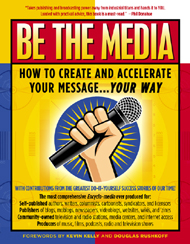
David Mathison, former CEO of Kinecta Corporation (purchased by Oracle) has written a book called Be the Media.  Great title.  The content is good, too, though a little shallow.  Mathison attempts to cover an ocean's range of subjects, and while the topics are a mile wide, they are only about a foot deep.  Actually, more like a yard deep, to be fair.  It's a good introduction to several areas, but probably nothing most indie producers don't already know.

Even better than the book, though, is Mathison's Be the Media Internet radio show on BlogTalk Radio.  He's got some impressive guests, and deeper discussions on the topics he scrapes the surface of in the book.  Recent guests included Seth Godin and Terry McBride.  So far, every episode I've heard has been good.  One of the best for filmmakers was this one, featuring distribution guru Peter Broderick.

I like the book, but cannot heartily recommend it.  But I do recommend Mathison's BTR podcast.  Check it out.

Monday, April 5, 2010

Instant jam session- just add iPhone


Musicians, have you ever felt the urge to have a jam session with some friends, to try out new ideas, or just commune with the muse, but found it too much hassle to get everyone together?  Well, check out LaDiDa, a new iPhone app that applies some old technology in new ways, to let you throw an instant "pickin' party."

Years ago, when I was playing a lot as a singer-songwriter, I missed the sound of a full band, and the chemistry of trying out new ideas instantly.  Digital recording systems are great, but they are very solitary affairs, and require you to not only know how to play your instruments, but also those of the musicians you are replacing with a computer (usually the drummer).

A clever piece of software called Band in a Box (PC only) used pre-programmed styles and (terrible) MIDI sound files to provide a backing band, complete with notation and arrangement options, but you had to do at least a little pre-planning, entering the number of measures, chord changes, tempo, key, and style for the program to do it's thing.

LaDiDa is different.  You hum.  That's it.  Literally hum into your iPhone, and LaDiDa figures out everything else on the fly, as you can see in the video.  Very, very, very impressive.  I'm curious to see if it responds to instruments as well as voice.  But even if not, it gives you a great starting point as a songwriter, allowing you to make changes on the fly, and it also gives you motivation to finish the song, since you can easily imagine how great it will sound when complete.

Check it out, and post some feedback of your experience here on this post.  Let me know what you think.

Friday, April 2, 2010

The Futures of Hollywood

A sample of movie futures soon to be on offer from the Cantor Exchange.
The Hollywood Stock Exchange has been around for 15 years.  It's a game where players bet on the "securities" of Hollywood properties, including make-believe stocks, bonds, and even derivatives.  In a truth-stranger-than-fiction move, Cantor-Fitzgerald, a Wall Street investment brokerage and consultancy, bought the HSX.  And now they are hoping to make reality out of fiction.

On April 20, 2010, the Commodity Futures Trading Commission (CFTC) expects to tell Cantor whether they will allow the new company, called the Cantor Exchange, to actually trade movie titles as securities (specifically, as futures).  This means we'll all be able to bet, literally, on whether a movie will make money or not.

This is an interesting twist on the "internal prediction markets" that are happening at companies like Google, who run an exchange to bet on the delivery dates and health of a particular project or product.  Movie returns have always been wildly unpredictable, so it will be interesting to see if commercializing our predictions adds any accuracy, and really makes anyone money (other than the Cantor Exchange, which takes a cut of every transaction), or, if William Goldman was right when he famously said, "Nobody knows anything."

If, like me, you predicted that Hot Tub Time Machine would have stunk up the box office, well, you probably would have lost your retirement fund.  Who knew?

Friday, March 26, 2010

The future of movie distribution

Next time you have a free hour and a half, enjoy this treatise on the future of movie distribution.  Me and many others have been saying the same thing for a few years now, but it's interesting to hear it straight from the horse's mouth, so to speak.  Mai is a former distributor sales agent.

Thanks to Lorie Marsh for hipping me to this presentation.


Thomas Mai Presentation ETMA, Strasbourg from Thomas Mai on Vimeo.


Wednesday, March 3, 2010

Stu Maschwitz set to direct Psy-Ops movie

Stu Maschwitz, author of the DV Rebel's Guide to Making Action Movies on the Cheap, and the incredible resource blog Prolost (get the RSS feed of this blog on our Texas Film Scene) has been tagged to direct the new biggish-budget film Psy-Ops. Excsssssellent. I'll be there.

Attention, Movie Tech Geeks: Great interview with Stu on why 24p rocks, here. Sorry, it's not embedable video (boo!).

Sunday, February 14, 2010

Amazing art!

Next time you think your movie needs lots of talky dialog, watch this video, and remember that we trade in a visual medium.


Saturday, February 6, 2010

Straight to Audience, not Straight to Video

I love this post by Sherri Candler, a Los Angeles-based low-budget film marketing advisor, where she suggests that we change the term "straight to video" (or straight to DVD) to "straight to audience." Amen!

Filmmakers have been doing this for decades, now, probably as far back as John Cassavetes. But the difference now is the presence of The Great Disintermediator- the Internet. Search engines, YouTube and it's ilk, and social networks have made it possible to find an audience simply by posting your content online. Doing that and only that will not necessarily gain you much traffic, or any money, but it can help you find what Kevin Kelly calls 1,000 true fans.

With such a core audience, you become your own distribution company, for whatever content you produce- movies, music, books, blogs, podcasts, speeches, etc. It's an approach I've been advocating for sometime here on this blog, and on the Texas Film Scene, and is also the thrust of a book I'm writing on entrepreneurship in the digital age (if you're interested in knowing when this book is shipping, email me).

Straight to audience is not as sexy as a box office release, but considering that most indie filmmakers now only score a box office release if they (a) get chosen by the Festival Gods, or (b) pay for their own 4-walling, it certainly is a lot cheaper. Straight to audience has also helped Texas filmmakers like Blake Calhoun and Mike Maden score pretty sweet Hollywood production deals on the strength of their straight-to-audience work. Besides- and I know this is heresy- on most nights, I would rather enjoy a movie on my dirt-cheap home theater system than pay $20+food+gas+babysitter for a movie ticket. At $35 per outing, it takes only 25 movies to recoup the cost of my 47-inch LCD. Avatar or Star Trek is a different story, of course.

Straight-to-audience also scares people because it sounds like sales, which it is. It's time for artists to stop fearing sales, and start embracing it. If you love what you're selling, then selling is no chore. If you don't, why are you making that movie, again?